



Sell Strategy, Not a Tax Hack: A Broker‑Safe Look at Section 125


Brokers don’t lose accounts because Section 125 is “bad.” They lose them when a cafeteria plan is sold like a product instead of a funding mechanism—especially when “wellness” is marketed like tax-free cash. Here’s a broker-safe way to frame Section 125 as part of compliant health-plan architecture (125 → 105 → 213(d))—without turning your credibility into collateral.
Section 125 in one minute: what it is, what it isn’t, and what to verify
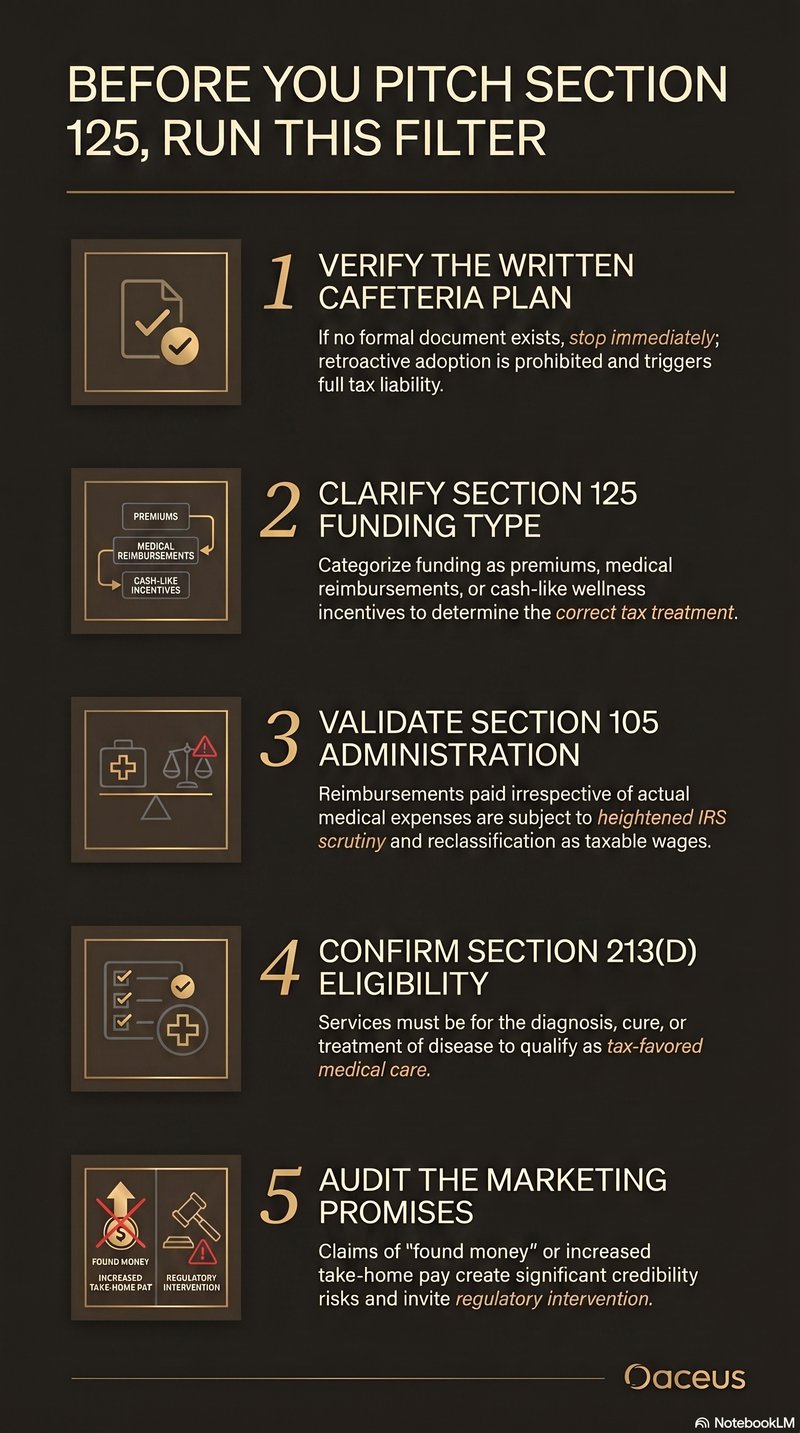
Section 125 is a pre-tax election and funding mechanism—not a benefit. The broker-safe diligence move is to ask what the cafeteria plan is funding, how reimbursements (if any) are administered under Section 105, and whether the “preventive” services are truly medical care under Section 213(d). Avoid “bigger paycheck” slogans, document assumptions, and treat any program combining pre-tax premiums with cash-like payments as a heightened scrutiny category.
Section 125 cafeteria plans for brokers: sell strategy, not a tax hack
The employer market is noisy with programs that promise quick savings, higher take-home pay, or “found money” if clients will reroute part of payroll. Many of those pitches reference a Section 125 cafeteria plan, but they often leave brokers carrying the credibility risk when the structure is thin—or when the marketing language goes too far.
A more durable approach is simpler: sell the strategy, not the tax mechanism. Section 125 can be an important part of compliant benefits architecture, but it’s not a benefit by itself—and it’s not a permission slip to turn “wellness cash” into tax-free dollars. IRS cafeteria plan FAQs

What Section 125 actually does (and what it does not do)
Section 125 of the Internal Revenue Code allows an employer to maintain a cafeteria plan so employees can choose between taxable pay and certain qualified benefits. In practice, this is commonly implemented through salary reduction elections that fund eligible benefits using pre-tax dollars (i.e., pre-tax benefits). IRS cafeteria plan FAQs
What matters for broker diligence:
- A Section 125 plan is a funding mechanism. It creates the pre-tax pathway; it doesn’t define clinical legitimacy, claims substantiation, or whether the underlying program is genuinely tax-favored medical care.
- It must be written and operated as written. If plan operations drift, employers can lose the intended tax treatment. Prop. Treas. Reg. §1.125 guidance (IRS Bulletin 2007-39)
Where employer contributions and employee contributions fit
Most cafeteria plans blend:
- Employee contributions via salary reduction (often what employees notice on the paystub), and sometimes
- Employer contributions (depending on plan design, eligibility, and nondiscrimination constraints).
Broker framing tip: treat “who funds what” as a documentation question (plan documents + payroll mapping), not a marketing claim.
The broker-safe frame: 125 → 105 → 213(d)
Most defensibility isn’t about Section 125 in isolation—it’s about what 125 is funding.

A broker-safe, diligence-first pattern looks like this:
- Section 125 provides the pre-tax election mechanism (salary reduction). IRS cafeteria plan FAQs
- Section 105 governs the tax treatment of amounts received under employer accident-and-health plans, including medical reimbursements that can be excluded from income when properly structured and administered. 26 U.S.C. §105
- Section 213(d) defines “medical care” (including diagnosis, cure, mitigation, treatment, or prevention of disease). 26 U.S.C. §213(d) definition
That “125 → 105 → 213(d)” framing forces the right question:
Are benefits structured and administered as medical care—or are they wellness-flavored cash equivalents wrapped in tax language?
Preventive health needs a medical-plan frame (not a wellness cash story)
The market blurs the line between wellness perks and medical benefits, but the tax rules don’t automatically follow marketing labels.
- IRS discussion of what can qualify as medical expenses is grounded in 213(d) and explained practically in Publication 502. IRS Publication 502
- If a design pays employees cash (or near-cash) without tying payments to substantiated medical expenses, it can create wage/income inclusion issues—especially when paired with pre-tax premium payments. IRS CCA 202323006 (PDF)
Broker takeaway: If “preventive care” is being marketed like a cash incentive program, slow down. The safest posture is to evaluate whether the program is truly administered as a medical benefit (definitions, substantiation, documentation), rather than as a payout concept.
Where FICA and paycheck impact fit (broker-safe language)
Yes—when qualified benefits are funded pre-tax through salary reduction, it can affect taxable wage calculations for certain payroll taxes and withholding outcomes, depending on benefit type and plan operation. IRS Publication 15 (Circular E)
But for public broker education, the most credible framing is:
- Designed and modeled; results vary
- Employee-level outcomes depend on elections, wages, withholding, and plan terms
- Avoid slogans like “bigger paychecks,” “free money,” or “guaranteed savings”
Why so strict? The IRS has scrutinized certain fixed-indemnity/wellness arrangements where pre-tax premiums and cash payments are combined, and has indicated scenarios where payments can become taxable wages when not tied to unreimbursed medical expenses. IRS CCA 202323006 (PDF)
Practical documentation reminder (W-2 awareness)
If an employer adopts a cafeteria plan approach, brokers should ensure clients understand:
- how elections are reflected in payroll,
- how amounts may (or may not) show up on the W-2 form, and
- what employee communications will say (to avoid “extra pay” messaging that contradicts the legal posture).
(Employers should confirm W-2 reporting details with their CPA/payroll provider; don’t wing it in marketing copy.)
Fast red flags brokers can spot (without becoming the compliance department)
Use this broker-safe checklist to pressure-test a proposal—without publishing anyone’s “recipe”:
- What exactly is the benefit? Care delivery, reimbursement, or both? Is there a clear group health plan frame?
- What medical-care definition is used? Is it explicitly tied to 213(d) medical care concepts? 213(d) definition
- How are reimbursements substantiated (if applicable)? Substantiation and operational discipline are core to defensibility under Section 105 concepts.
- Does the marketing match the legal posture? “Extra pay” messaging is a structural warning light. (Discuss structures, not vendors.)
- How mature is Section 125 plan administration? Who is the third-party administrator (if any), what are the maintenance costs and ongoing fee structure, and who owns employee support?
- Are nondiscrimination rules discussed in plain English? Ask how the program manages risk around compensated participants and key employee testing during the plan year.
- How do benefits election changes work? Mid-year benefits election changes should be handled conservatively and consistently with cafeteria plan rules—especially around life events.
Where Oaceus fits (high level, broker-safe)
Oaceus positions its approach as preventive, early-intervention care infrastructure—not a wellness cash pitch—designed to improve access and manage workforce risk, with tax effects that are modeled and eligibility-dependent, not a universal promise. See:
- Oaceus broker portal (broker.oaceus.com)
- 360° plan overview (oaceus.com)
- 360° for employers (oaceus.com)
- Plan FAQs (employee experience, family/spouse coverage concepts) (php.oaceus.com)
Broker-facing positioning that stays credible:
- Start with care access + prevention + risk management
- Treat tax outcomes as design-dependent and population-dependent
- Keep your core benefits story intact (medical, dental, vision) and use preventive architecture as an add-on strategy—not a replacement
Broker economics (commission) without compromising credibility
Brokers understandably ask, “How does commission work, and does this cannibalize my book?” The broker-safe answer is to keep comp conversations separate from compliance claims:
- Confirm whether comp is commission-based or fee-based at the partner level (and document it).
- Ensure the client narrative stays focused on health coverage strategy, administration, and outcomes—not broker comp.
(If you’re evaluating Oaceus specifically, start inside the broker onboarding flow and align on comp structure there.) Oaceus broker portal (broker.oaceus.com)
What this means for brokers
Brokers win long-term by bringing employers structures they can defend—especially when the scrutiny cycle inevitably hits whatever the market is over-marketing.
A practical next step is to treat Section 125-heavy offerings as a due diligence category, not a commodity: ask how the cafeteria plan interacts with the underlying medical plan, how 213(d)-grounded medical care is defined, and how any reimbursement/substantiation is documented and administered.
CTA
If you want a compliance-first walkthrough (high level, not a DIY blueprint) of how Section 125, 105, and 213(d) interact in Oaceus’ preventive health architecture, request broker onboarding or contact the team:
Is a Section 125 cafeteria plan a benefit?
No. Section 125 is generally the election/funding mechanism that can allow employees to pay for certain qualified benefits with pre-tax dollars; the benefit is the underlying plan or coverage. IRS cafeteria plan FAQs
Does Section 125 require minimum essential coverage (MEC)?
Not inherently. A cafeteria plan can be used for different eligible benefit elections, and minimum essential coverage / a MEC plan is a separate coverage concept under ACA-related rules. If an offering mentions MEC, treat it as a separate diligence thread (coverage type, disclosures, employee communications) and confirm with the employer’s counsel/ACA reporting partner.
What does 213(d) mean in plain English?
It defines “medical care” broadly as amounts paid for diagnosis, cure, mitigation, treatment, or prevention of disease (and certain related categories). 213(d) definition
Why are “wellness” cash payments risky when paired with pre-tax premiums?
Because IRS guidance has addressed scenarios where fixed payments may be treated as taxable benefits (taxable wages) when not tied to unreimbursed medical expenses—especially when premiums were paid pre-tax through a cafeteria plan. IRS CCA 202323006 (PDF)
Can spouses be covered?
Some preventive-health designs extend access to services for a spouse and family members, but “who is eligible” is a plan design and administration question. Confirm eligibility language in the governing documents and employee communications. (For the Oaceus employee experience, see the plan FAQ page.) Oaceus FAQs (php.oaceus.com)