



Preventive health vs. wellness: the IRS line (and why audit readiness matters)


Quick answer for CFOs and counsel
If you’re evaluating an employer benefit that’s marketed as “preventive” or “wellness,” the safest way to think about it is this:
- The IRS cares less about the label and more about the behavior of the benefit.
- Preventive medical benefits are designed and administered like medical care (diagnosis, treatment, prevention of disease, and clinically grounded services)—often as part of a broader employee health plan or EHP plan posture.
- Employee wellness incentives (especially those that behave like cash or compensation) can create tax and payroll exposure when they’re not clearly limited to qualifying medical care concepts.
This is why the diligence question is rarely “Is wellness deductible?”
It’s usually:
- “Could this be treated as taxable wages?”
- “If it is, who handles withholding and employment taxes (including FICA taxes and other mandatory payroll expenses)?”
- “Can we explain, document, and administer this consistently years after launch?”
That last point is the heart of audit readiness.
Why this question is showing up more in 2026
Employer healthcare spend is under pressure, and “benefits innovation” has gotten louder—and noisier.
For example, Mercer’s 2025 National Survey of Employer-Sponsored Health Plans reported that total health benefit cost per employee is expected to rise 6.5% on average in 2026, described as the highest increase since 2010 (even after planned cost-reduction measures). See: Mercer: employers are bracing for the highest health benefit cost increase in 15 years.
In that environment, CFOs and counsel tend to run the same play:
- Assume the offer is too good to be true (especially when “significant tax advantages” or “tax mitigation” are front-and-center in the pitch)
- Search for the enforcement risk (IRS scrutiny, IRS tax treatment / wage treatment, fixed-indemnity issues, and broader compliance questions under ERISA and the ACA)
- Only then consider the operational story (implementation, employee experience)
If your content doesn’t meet them at Step 2, you don’t get a meeting.
More importantly: if the program you’re evaluating can’t answer Step 2 cleanly, you have a problem regardless of how well the sales deck reads.
What the IRS means by “medical care” (plain English)
If you want the cleanest baseline definition to anchor your internal discussions, start with the IRS’s description of medical care under Section 213: costs related to diagnosis, cure, mitigation, treatment, or prevention of disease, and for the purpose of affecting any part or function of the body.
That framing matters because it separates:
- clinically grounded care access (medical care)
- general health, lifestyle, and engagement programs (i.e., wellness program benefits that may be valuable, but don’t automatically qualify as medical care)
For a practical example of how the IRS discusses nutrition, wellness, and general health costs in the 213 context, see: medical expenses related to nutrition, wellness, and general health.
The core distinction: medical benefit behavior vs. compensation behavior
Here’s a conservative way to draw the line without getting lost in marketing language.
Preventive medical benefits usually look like
- Access to clinicians and medically necessary services
- Benefits tied to medical care concepts (eligibility, coverage, documentation, administration)—supporting comprehensive health coverage rather than “rewards”
- A plan posture that can be explained to an auditor as: “this was designed as a health benefit and operated as such”
For context on the employee experience side of a preventive-health-first benefit design, see: employee preventive health plan support.

Wellness incentives often drift into risk when they look like
- Cash-like payments
- Fixed “rewards” triggered by wellness program participation, regardless of whether the participant actually incurred unreimbursed medical expenses (or whether any reimbursed medical expenses were substantiated under plan rules)
- Marketing that emphasizes tax outcomes over medical purpose (or uses language that signals the wrong intent to a reviewer)
- “Win-win plan” framing that sounds like compensation engineering more than employer-provided health benefits
The risk isn’t theoretical. When something behaves like compensation, payroll and tax treatment questions follow—especially for taxable wellness payments that may need to be included in employees gross income and, in some cases, treated as wages.
Why “wellness payments” can become taxable wages
This is where many well-intended programs fail CFO diligence.
The problem in one sentence
If an employee receives a payment that isn’t limited to reimbursement of qualifying medical expenses (or isn’t coordinated in a defensible way), that payment can be treated as gross income—and potentially wages—even if it’s packaged inside an employer-sponsored benefits story (including an employer-funded wellness program).
The memo everyone cites: IRS CCA 202323006
A commonly cited reference point is IRS Chief Counsel Advice 202323006: IRS CCA 202323006 (PDF).
It’s nonprecedential, but it’s influential because it reinforced a practical warning consistent with broader IRS guidance: when a program pays fixed wellness amounts that are not tied to unreimbursed medical expenses, employers can face income and employment tax implications.
This is why practitioners often summarize it as “the IRS clarifies taxation” of certain fixed designs—particularly fixed-indemnity wellness plans that resemble a fixed-indemnity health insurance policy paying a specified amount for an activity rather than for substantiated medical care (i.e., fixed-indemnity wellness plan payments).
For a plain-language legal summary of the same memo, see: Fixed-indemnity wellness plans: taxation of wellness payments.
For additional practitioner commentary in the same direction, see: ‘Wellness’ doesn’t come tax-free (Steptoe).
What “audit readiness” actually means (a CFO definition)
“Audit readiness” should not mean “we think this will never get audited.”
A CFO-grade definition is simpler:
Audit readiness is your ability to explain, document, and administer the program consistently with its intended tax and benefits treatment—years after launch.
The programs that fail aren’t always the ones that were designed wrong. Some fail because implementation drifted from the design. Some fail because communications created impressions that the documents couldn’t support. Some fail because governance responsibility was never clearly assigned—and by the time anyone asked, the records weren’t there.
If you want the deeper governance view, read: audit readiness for Section 125/105 health benefits (including how a section 125 cafeteria plan can interact with pre-tax salary deferrals and the deferred amount an employee elects to set aside).
The audit readiness framework (five pillars)
Use these as diligence lenses. They’re intentionally principle-based—because publishing a DIY blueprint is not the goal.
1) Written plan discipline
If a plan requires written documents, audit readiness starts with having them—and operating the program the way those documents say you operate it.
This is especially true when vendors blur lines between “comprehensive wellness program reimbursements” and compensation-like payments: if it’s positioned as reimbursement, you’ll need the substantiation story (and any fair market value / fair market value concepts) to match.
2) Substance over labels
If the program is marketed as “preventive” but functions like compensation, the label won’t save you.
A helpful internal test is: could you describe this program to counsel without using the words “wellness,” “cash,” “rebate,” or “tax-free”?
Also: be cautious of wellness plan schemes where the “benefit” is essentially a fixed schedule for actions like screenings, steps, or vaccinations—particularly if the payments are payable regardless of whether the employee incurred qualifying medical expenses.
3) Documentation and governance ownership
Audit readiness rises when responsibility is clear.
- Who owns tax characterization decisions (and the IRS tax treatment position)?
- Who owns payroll treatment if anything is treated as wages?
- Who owns employee communications (and approvals) so you don’t create audit exhibits?
This is also where serious teams pressure-test how a position would read if it were reviewed by an IRS office function years later, or discussed through the lens of Chief Counsel reasoning (without overstating what a memo does or doesn’t control).
4) Operational feasibility
A program can be theoretically defensible and practically dangerous.
If the correct tax treatment depends on data you don’t reliably have (or receive late), the plan becomes hard to operate consistently. CFOs should treat that as a governance risk, not an HR inconvenience.
5) Conservative communications
Avoid marketing language that creates the exact impression auditors dislike:
- “IRS-proof”
- “guaranteed savings”
- “tax-free cash”
- “no-cost for everyone”
Instead, use language that signals discipline:
- “designed for audit readiness”
- “subject to employer facts, plan terms, and administration”
- “intended to align with applicable rules and guidance”
Conservative communications isn’t PR. It’s part of how a program demonstrates that it was designed as a health benefit—not a compensation workaround.
The diligence questions to ask (without asking for a DIY playbook)
These questions are designed for CFOs, counsel, and brokers who want to be able to defend the decision later.
Questions for your CPA / payroll tax advisor
- Under what circumstances could employee-facing value be treated as taxable wages (and included in employees gross income)?
- If anything is wages, how will withholding and employment taxes be handled (including FICA taxes)?
- What documentation would you expect to see to support the intended treatment (including any specific tax exemption theory being relied on, if any)?
Questions for ERISA counsel
- Is the arrangement being presented as a health plan, and does it operate like one (vs. a fixed-indemnity wrapper around wellness)?
- Do plan documents and employee communications align?
- Who has fiduciary and governance responsibility internally?
Questions for your broker / vendor
- How do you describe this conservatively (without selling a tax outcome)?
- What are the operational failure modes you’ve seen in the field?
- What does your audit readiness posture look like at a high level?
- If challenged, what would you point to from IRS guidance and how the IRS clarifies taxation in practice (without over-reading a Chief Counsel memo as “binding law”)?
- How do you address enforcement risk in communications without creating it?
What this means by persona (so your internal conversation stays aligned)
| Persona | Their real risk concern | What they need to be able to say |
|---|---|---|
| CFO | “Will this look unsound later?” | “This is a medically grounded benefit design with governance discipline.” |
| Counsel/CPA | “Is the treatment defensible?” | “The program is documented, operated consistently, and communication is conservative.” |
| Broker | “Can I safely introduce this?” | “This is positioned as preventive health infrastructure, not a tax play.” |
| HR | “Will I inherit a mess?” | “Implementation is supported, and the program reduces friction rather than adding it.” |
Oaceus 360 is designed around:
- A preventive-first care experience for employees and families (for each employee their eligible dependents, where applicable)
- A compliance-forward posture that prioritizes governance, documentation, and conservative communications
- Administration designed to be operationally feasible (so the program can be run consistently), supporting comprehensive health coverage rather than a compensation-like wellness add-on
If you’re evaluating a preventive health approach for your organization, start here: employer preventive health plan overview.
If you’d like to understand the mission and principles behind the approach, see: Oaceus preventive healthcare leadership.
If you want to pressure-test the governance lens first, start here: audit readiness for Section 125/105 health benefits.
Diligence library
- Audit readiness for benefits programs: what CFOs should require: audit readiness for Section 125/105 health benefits
- Employer overview (high level, not a sales deck): employer preventive health plan overview
- Employee experience (what people actually get): employee preventive health plan support
- Who we are and why we built this: Oaceus preventive healthcare leadership
Pressure-test this with a compliance-first walkthrough
If you want to pressure-test your situation without hype and without a DIY blueprint, request a compliance-first walkthrough here: talk with Oaceus.
We’ll focus on:
- Governance (who owns what)
- Documentation discipline (what must exist and match)
- Operational feasibility (can payroll and administration run it consistently)
FAQ (for CFOs, counsel, and brokers)
What is “medical care” under IRS Section 213?
In plain English, it’s expense and benefit design that connects to diagnosis, treatment, mitigation, or prevention of disease (and certain function-of-the-body concepts)—not general lifestyle or “feel-good” spending.
Can wellness incentive payments be treated as taxable wages?
They can be, especially when they behave like compensation (cash-like payments or fixed rewards not tied to unreimbursed medical expenses). That wage-risk framing is one reason CCA 202323006 gets cited in diligence conversations, particularly for fixed-indemnity wellness plans and other fixed-indemnity wellness plan payments designs.
What is IRS CCA 202323006 and why do people cite it?
It’s a nonprecedential Chief Counsel memo that analyzed a fixed-indemnity wellness payment fact pattern and reinforced that certain wellness payments may be taxable when not tied to unreimbursed medical expenses. It’s frequently cited because it reflects how the IRS thinks about substance and wage treatment risk—and how the IRS clarifies taxation in practice even when the document is nonprecedential.
What does “audit readiness” mean for Section 125/105 benefit designs?
It means you can defend the program later with evidence: documents, governance ownership, consistent administration, and conservative communications that match the intended treatment—especially where a section 125 cafeteria plan election, pre-tax salary deferrals, or other employer-provided health benefits interactions exist.
How should employers talk about preventive health benefits to stay conservative?
Avoid language that sells a tax outcome. Use language that emphasizes medical purpose, governance discipline, and the reality that results and treatment depend on employer facts, plan terms, and administration.Preventive health vs. wellness: the IRS line (and why audit readiness matters)
Quick answer for CFOs and counsel
If you’re evaluating an employer benefit that’s marketed as “preventive” or “wellness,” the safest way to think about it is this:
- The IRS cares less about the label and more about the behavior of the benefit.
- Preventive medical benefits are designed and administered like medical care (diagnosis, treatment, prevention of disease, and clinically grounded services)—often as part of a broader employee health plan or EHP plan posture.
- Employee wellness incentives (especially those that behave like cash or compensation) can create tax and payroll exposure when they’re not clearly limited to qualifying medical care concepts.
This is why the diligence question is rarely “Is wellness deductible?”
It’s usually:
- “Could this be treated as taxable wages?”
- “If it is, who handles withholding and employment taxes (including FICA taxes and other mandatory payroll expenses)?”
- “Can we explain, document, and administer this consistently years after launch?”
That last point is the heart of audit readiness.
Why this question is showing up more in 2026
Employer healthcare spend is under pressure, and “benefits innovation” has gotten louder—and noisier.
For example, Mercer’s 2025 National Survey of Employer-Sponsored Health Plans reported that total health benefit cost per employee is expected to rise 6.5% on average in 2026, described as the highest increase since 2010 (even after planned cost-reduction measures). See: Mercer: employers are bracing for the highest health benefit cost increase in 15 years.

In that environment, CFOs and counsel tend to run the same play:
- Assume the offer is too good to be true (especially when “significant tax advantages” or “tax mitigation” are front-and-center in the pitch)
- Search for the enforcement risk (IRS scrutiny, IRS tax treatment / wage treatment, fixed-indemnity issues, and broader compliance questions under ERISA and the ACA)
- Only then consider the operational story (implementation, employee experience)
If your content doesn’t meet them at Step 2, you don’t get a meeting.
More importantly: if the program you’re evaluating can’t answer Step 2 cleanly, you have a problem regardless of how well the sales deck reads.
What the IRS means by “medical care” (plain English)
If you want the cleanest baseline definition to anchor your internal discussions, start with the IRS’s description of medical care under Section 213: costs related to diagnosis, cure, mitigation, treatment, or prevention of disease, and for the purpose of affecting any part or function of the body.
That framing matters because it separates:
- clinically grounded care access (medical care)
- general health, lifestyle, and engagement programs (i.e., wellness program benefits that may be valuable, but don’t automatically qualify as medical care)
For a practical example of how the IRS discusses nutrition, wellness, and general health costs in the 213 context, see: medical expenses related to nutrition, wellness, and general health.
The core distinction: medical benefit behavior vs. compensation behavior
Here’s a conservative way to draw the line without getting lost in marketing language.
Preventive medical benefits usually look like
- Access to clinicians and medically necessary services
- Benefits tied to medical care concepts (eligibility, coverage, documentation, administration)—supporting comprehensive health coverage rather than “rewards”
- A plan posture that can be explained to an auditor as: “this was designed as a health benefit and operated as such”
For context on the employee experience side of a preventive-health-first benefit design, see: employee preventive health plan support.
Wellness incentives often drift into risk when they look like
- Cash-like payments
- Fixed “rewards” triggered by wellness program participation, regardless of whether the participant actually incurred unreimbursed medical expenses (or whether any reimbursed medical expenses were substantiated under plan rules)
- Marketing that emphasizes tax outcomes over medical purpose (or uses language that signals the wrong intent to a reviewer)
- “Win-win plan” framing that sounds like compensation engineering more than employer-provided health benefits
The risk isn’t theoretical. When something behaves like compensation, payroll and tax treatment questions follow—especially for taxable wellness payments that may need to be included in employees gross income and, in some cases, treated as wages.
Why “wellness payments” can become taxable wages
This is where many well-intended programs fail CFO diligence.
The problem in one sentence
If an employee receives a payment that isn’t limited to reimbursement of qualifying medical expenses (or isn’t coordinated in a defensible way), that payment can be treated as gross income—and potentially wages—even if it’s packaged inside an employer-sponsored benefits story (including an employer-funded wellness program).
The memo everyone cites: IRS CCA 202323006
A commonly cited reference point is IRS Chief Counsel Advice 202323006: IRS CCA 202323006 (PDF).
It’s nonprecedential, but it’s influential because it reinforced a practical warning consistent with broader IRS guidance: when a program pays fixed wellness amounts that are not tied to unreimbursed medical expenses, employers can face income and employment tax implications.
This is why practitioners often summarize it as “the IRS clarifies taxation” of certain fixed designs—particularly fixed-indemnity wellness plans that resemble a fixed-indemnity health insurance policy paying a specified amount for an activity rather than for substantiated medical care (i.e., fixed-indemnity wellness plan payments).
For a plain-language legal summary of the same memo, see: Fixed-indemnity wellness plans: taxation of wellness payments.
For additional practitioner commentary in the same direction, see: ‘Wellness’ doesn’t come tax-free (Steptoe).
What “audit readiness” actually means (a CFO definition)
“Audit readiness” should not mean “we think this will never get audited.”
A CFO-grade definition is simpler:
Audit readiness is your ability to explain, document, and administer the program consistently with its intended tax and benefits treatment—years after launch.
The programs that fail aren’t always the ones that were designed wrong. Some fail because implementation drifted from the design. Some fail because communications created impressions that the documents couldn’t support. Some fail because governance responsibility was never clearly assigned—and by the time anyone asked, the records weren’t there.
If you want the deeper governance view, read: audit readiness for Section 125/105 health benefits (including how a section 125 cafeteria plan can interact with pre-tax salary deferrals and the deferred amount an employee elects to set aside).
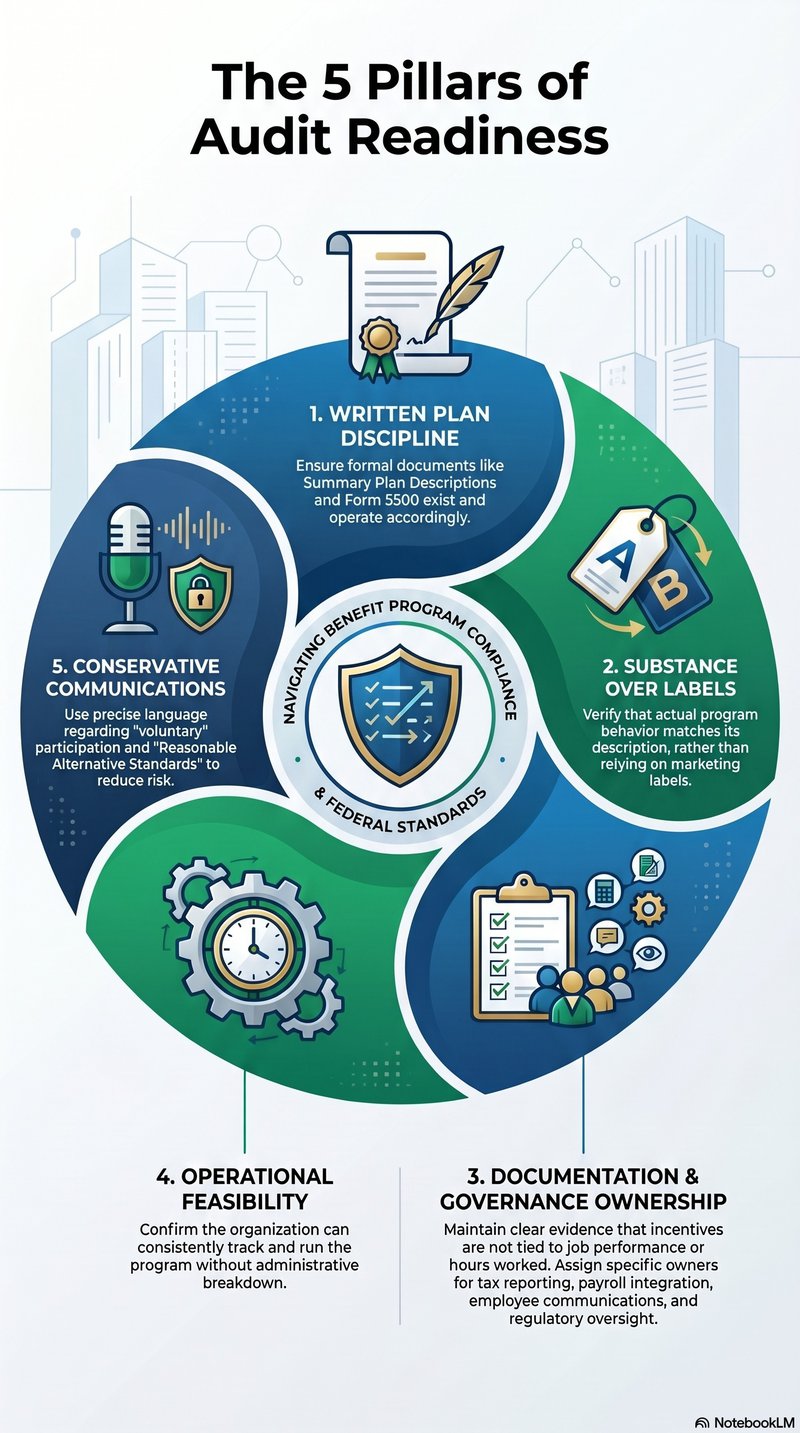
The audit readiness framework (five pillars)
Use these as diligence lenses. They’re intentionally principle-based—because publishing a DIY blueprint is not the goal.
1) Written plan discipline
If a plan requires written documents, audit readiness starts with having them—and operating the program the way those documents say you operate it.
This is especially true when vendors blur lines between “comprehensive wellness program reimbursements” and compensation-like payments: if it’s positioned as reimbursement, you’ll need the substantiation story (and any fair market value / fair market value concepts) to match.
2) Substance over labels
If the program is marketed as “preventive” but functions like compensation, the label won’t save you.
A helpful internal test is: could you describe this program to counsel without using the words “wellness,” “cash,” “rebate,” or “tax-free”?
Also: be cautious of wellness plan schemes where the “benefit” is essentially a fixed schedule for actions like screenings, steps, or vaccinations—particularly if the payments are payable regardless of whether the employee incurred qualifying medical expenses.
3) Documentation and governance ownership
Audit readiness rises when responsibility is clear.
- Who owns tax characterization decisions (and the IRS tax treatment position)?
- Who owns payroll treatment if anything is treated as wages?
- Who owns employee communications (and approvals) so you don’t create audit exhibits?
This is also where serious teams pressure-test how a position would read if it were reviewed by an IRS office function years later, or discussed through the lens of Chief Counsel reasoning (without overstating what a memo does or doesn’t control).
4) Operational feasibility
A program can be theoretically defensible and practically dangerous.
If the correct tax treatment depends on data you don’t reliably have (or receive late), the plan becomes hard to operate consistently. CFOs should treat that as a governance risk, not an HR inconvenience.
5) Conservative communications
Avoid marketing language that creates the exact impression auditors dislike:
- “IRS-proof”
- “guaranteed savings”
- “tax-free cash”
- “no-cost for everyone”
Instead, use language that signals discipline:
- “designed for audit readiness”
- “subject to employer facts, plan terms, and administration”
- “intended to align with applicable rules and guidance”
Conservative communications isn’t PR. It’s part of how a program demonstrates that it was designed as a health benefit—not a compensation workaround.
The diligence questions to ask (without asking for a DIY playbook)
These questions are designed for CFOs, counsel, and brokers who want to be able to defend the decision later.
Questions for your CPA / payroll tax advisor
- Under what circumstances could employee-facing value be treated as taxable wages (and included in employees gross income)?
- If anything is wages, how will withholding and employment taxes be handled (including FICA taxes)?
- What documentation would you expect to see to support the intended treatment (including any specific tax exemption theory being relied on, if any)?
Questions for ERISA counsel
- Is the arrangement being presented as a health plan, and does it operate like one (vs. a fixed-indemnity wrapper around wellness)?
- Do plan documents and employee communications align?
- Who has fiduciary and governance responsibility internally?
Questions for your broker / vendor
- How do you describe this conservatively (without selling a tax outcome)?
- What are the operational failure modes you’ve seen in the field?
- What does your audit readiness posture look like at a high level?
- If challenged, what would you point to from IRS guidance and how the IRS clarifies taxation in practice (without over-reading a Chief Counsel memo as “binding law”)?
- How do you address enforcement risk in communications without creating it?
What this means by persona (so your internal conversation stays aligned)
| Persona | Their real risk concern | What they need to be able to say |
|---|---|---|
| CFO | “Will this look unsound later?” | “This is a medically grounded benefit design with governance discipline.” |
| Counsel/CPA | “Is the treatment defensible?” | “The program is documented, operated consistently, and communication is conservative.” |
| Broker | “Can I safely introduce this?” | “This is positioned as preventive health infrastructure, not a tax play.” |
| HR | “Will I inherit a mess?” | “Implementation is supported, and the program reduces friction rather than adding it.” |
Oaceus 360 is designed around:
- A preventive-first care experience for employees and families (for each employee their eligible dependents, where applicable)
- A compliance-forward posture that prioritizes governance, documentation, and conservative communications
- Administration designed to be operationally feasible (so the program can be run consistently), supporting comprehensive health coverage rather than a compensation-like wellness add-on
If you’re evaluating a preventive health approach for your organization, start here: employer preventive health plan overview.
If you’d like to understand the mission and principles behind the approach, see: Oaceus preventive healthcare leadership.
If you want to pressure-test the governance lens first, start here: audit readiness for Section 125/105 health benefits.
Diligence library
- Audit readiness for benefits programs: what CFOs should require: audit readiness for Section 125/105 health benefits
- Employer overview (high level, not a sales deck): employer preventive health plan overview
- Employee experience (what people actually get): employee preventive health plan support
- Who we are and why we built this: Oaceus preventive healthcare leadership
Pressure-test this with a compliance-first walkthrough
If you want to pressure-test your situation without hype and without a DIY blueprint, request a compliance-first walkthrough here: talk with Oaceus.
We’ll focus on:
- Governance (who owns what)
- Documentation discipline (what must exist and match)
- Operational feasibility (can payroll and administration run it consistently)
FAQ (for CFOs, counsel, and brokers)
What is “medical care” under IRS Section 213?
In plain English, it’s expense and benefit design that connects to diagnosis, treatment, mitigation, or prevention of disease (and certain function-of-the-body concepts)—not general lifestyle or “feel-good” spending.
Can wellness incentive payments be treated as taxable wages?
They can be, especially when they behave like compensation (cash-like payments or fixed rewards not tied to unreimbursed medical expenses). That wage-risk framing is one reason CCA 202323006 gets cited in diligence conversations, particularly for fixed-indemnity wellness plans and other fixed-indemnity wellness plan payments designs.
What is IRS CCA 202323006 and why do people cite it?
It’s a nonprecedential Chief Counsel memo that analyzed a fixed-indemnity wellness payment fact pattern and reinforced that certain wellness payments may be taxable when not tied to unreimbursed medical expenses. It’s frequently cited because it reflects how the IRS thinks about substance and wage treatment risk—and how the IRS clarifies taxation in practice even when the document is nonprecedential.
What does “audit readiness” mean for Section 125/105 benefit designs?
It means you can defend the program later with evidence: documents, governance ownership, consistent administration, and conservative communications that match the intended treatment—especially where a section 125 cafeteria plan election, pre-tax salary deferrals, or other employer-provided health benefits interactions exist.
How should employers talk about preventive health benefits to stay conservative?
Avoid language that sells a tax outcome. Use language that emphasizes medical purpose, governance discipline, and the reality that results and treatment depend on employer facts, plan terms, and administration.